Rising on Air
Math lessons that kept children learning at home through radio, newspapers and SMS when COVID-19 closed schools.
The brief
COVID-19 closed schools in Sierra Leone and Liberia. Children needed math lessons that worked through commonly available means: national radio, newspapers and SMS.
What I did
Led the Grades 1–6 math curriculum: 20 modules of audio lessons built on mental math, prediction and problems students solve along with the presenter.
What happened
Within a year the program reached more than 12 million children in 25 countries, and its free scripts were adapted into at least nine languages.
Organization
Rising Academies
Role
Curriculum Fellow
Learners
Primary, Grades 1–6
Format
Radio lessons
Focus
Mathematics, audio learning, educational access
Where and when
Launched 2020 in Sierra Leone and Liberia, later used in 25 countries
How do you teach a math lesson when students can't see you, can't see a screen, and can't raise their hands?
Context
Rising on Air took the classroom to the radio, ensuring that learning still happened in students' homes. Rising built it in the weeks after COVID-19 closed schools in Sierra Leone and Liberia, where only one in eight people had internet access. As a Curriculum Fellow, I led the development of its primary math curriculum for Grades 1–6. At its heart were interactive radio lessons, with chances for students to call in and share their answers to problems. Printable worksheets went out in newspapers, and assessments and parent check-ins ran by SMS.
Design challenge
Math is usually taught with diagrams, written problems and a teacher working through steps on the board. Radio takes most of that away. We had to work out how students would make sense of an idea they couldn't see, give them something to think about and do rather than just listen to, and use the newspaper printables and SMS for what sound alone couldn't carry.
My role
I led development of the Grades 1–6 math curriculum, adapting classroom strategies for an audio-first format. I structured the explanations, wrote problems students could solve in their heads or on paper, and built in moments for them to take part.
Approach
- Designing for the ear. Without visuals, language does the teaching. Ideas needed clear descriptions, careful sequencing and examples students could picture or connect to their own lives.
- Making listening active. A stream of explanation loses listeners fast. Lessons regularly asked students to stop, think, calculate, predict or explain, creating moments of participation in a one-way medium.
- Working within constraints. Every instruction, example, question and transition had to help a student follow the math at home, often without an adult who could help.
Outcomes and evidence
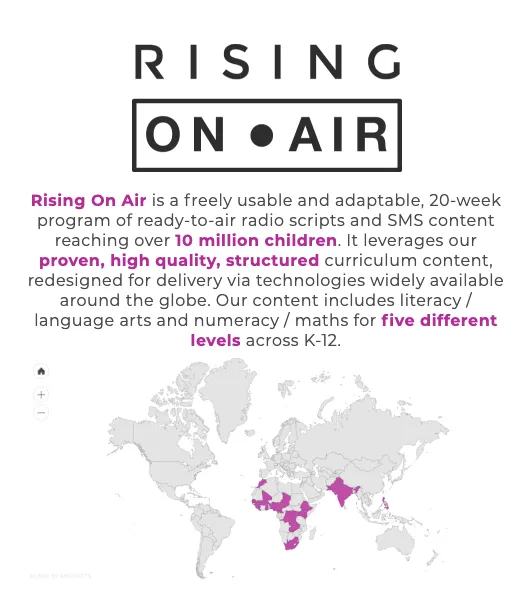
Within a year, the program had reached more than 12 million children in 25 countries across Africa and Asia, through more than 35 partner organizations. Its free, openly licensed scripts were adapted into at least nine languages. HundrED named it one of 100 innovations changing global education in 2021, and it won the mEducation Alliance's 2021 literacy award. A partner at India's Akanksha Foundation called one script "a treat to read." (Figures from Rising Academies.)
What I learned
Engaging learning doesn't depend on sophisticated technology. With careful design, even radio can create room for curiosity and problem-solving. It also taught me to treat constraints as invitations to rethink how learning happens, not just obstacles.
Links
Tell me what you're building
Have a learning experience in mind, or just a hunch? I'd love to hear about it.
Start a conversation